News and events
Vietnam Develops a Roadmap to Improve Aquatic Animal Welfare
Unofficial translation by MCD
On June, 29th, 2026, the Department of Fisheries and Surveillance, in collaboration with the Centre for Marinelife Conservation and Community Development (MCD), organized a technical consultation meeting on developing a roadmap for improving aquatic animal welfare.
The concept of “animal welfare” is widely recognized around the world but remains relatively new in Vietnam. Simply put, animal welfare refers to ensuring that animals are treated humanely so that they maintain good physical and mental well-being. In agricultural countries such as Vietnam, animal welfare is one of the fundamental prerequisites for sustainable development. Improving animal welfare not only benefits animals themselves but also contributes to human health and supports national and global food security and food safety.
In recent years, the concept of “animal welfare” has attracted increasing attention across various production sectors, including aquaculture. It is no longer merely an ethical consideration but has become a mandatory requirement under many international standards (governing production, harvesting, transportation, storage, processing, and export) to ensure sustainable development. At present, the fisheries sector, together with many related industries, requires comprehensive information on animal welfare (based on international standards), including definitions, theoretical frameworks, animals’ essential needs, the distinction between animal welfare and animal health, and specific welfare assessment indicators.
Vietnam is currently facing increasing competition in the European Union (EU) market. In this context, compliance with animal welfare standards may become an indirect competitive advantage for countries that have long adopted large-scale, low-cost production models and achieved high levels of international certification. For example, Ecuador, which currently holds a dominant share of the EU shrimp market, has a significantly higher proportion of shrimp certified under internationally recognized sustainability standards than Vietnam. Ecuador also benefits from an integrated production chain that facilitates the adoption of new technologies. Meanwhile, India’s aquaculture industry, with its advantages in large-scale production and low production costs, is also rapidly expanding its presence in major importing markets (particularly the United States).
These developments demonstrate that meeting aquatic animal welfare standards is not only part of corporate social responsibility but also an essential requirement for maintaining market share and gaining deeper access to demanding markets such as the EU, the United States, and Japan, etc. Vietnamese seafood exporters should therefore recognize aquatic animal welfare as an integral component of their sustainable development strategies and begin preparing proactively to seize future opportunities, rather than responding only after such requirements become mandatory.
At present, aquatic animal welfare has become an important issue in the global fisheries sector. In aquaculture in particular, the rapid growth of the industry has created an urgent need to protect and improve the welfare of aquatic animals. This includes ensuring appropriate living environments, farming conditions, and animal health, as well as applying proper practices during harvesting, transportation, handling, and processing. These measures not only contribute to improving product quality but also support the sustainable development of the aquaculture sector.
Aquatic animal welfare and sustainable development
Recognizing the importance of aquatic animal welfare in achieving sustainable development goals, on the afternoon of 29 June 2026, the Department of Fisheries and Surveillance under the Ministry of Agriculture and Environment, in collaboration with the Centre for Marinelife Conservation and Community Development (MCD), organized a Technical consultation meeting on developing a roadmap for improving aquatic animal welfare in Vietnam. During the meeting, government agencies, local authorities, businesses, and research institutions engaged in open discussions and actively shared their knowledge and experiences to develop a roadmap for improving the welfare of farmed aquatic animals in Vietnam. The meeting was co-chaired by Mr. Nhu Van Can, Deputy Director General of the Department of Fisheries and Surveillance, and Ms. Nguyen Thu Hue, Director of MCD.
Participants included representatives from various departments under the Department of Fisheries and Surveillance, including the Division of Aquaculture, the Division of Aquatic Breeds and Feeds, the Division of Aquatic Animal Health Management, the Division of Science, Technology and International Cooperation, and the Fisheries and Fisheries Surveillance Information Centre. Representatives also attended from the Vietnam Fisheries Science Institute (including the Centre for Fisheries Economics and Planning and the Aquaculture Research Centre); the Departments of Agriculture and Environment of Ca Mau Province and Can Tho City; the Fisheries and Surveillance Sub-departments of Can Tho and Ninh Binh; the Sub-department of Seas, Islands, Fisheries and Fisheries Surveillance of Quang Ninh Province; the Vietnam Association of Seafood Exporters and Producers (VASEP); universities; research centres; seafood enterprises; shrimp and fish farmers; as well as experts and other relevant organizations.
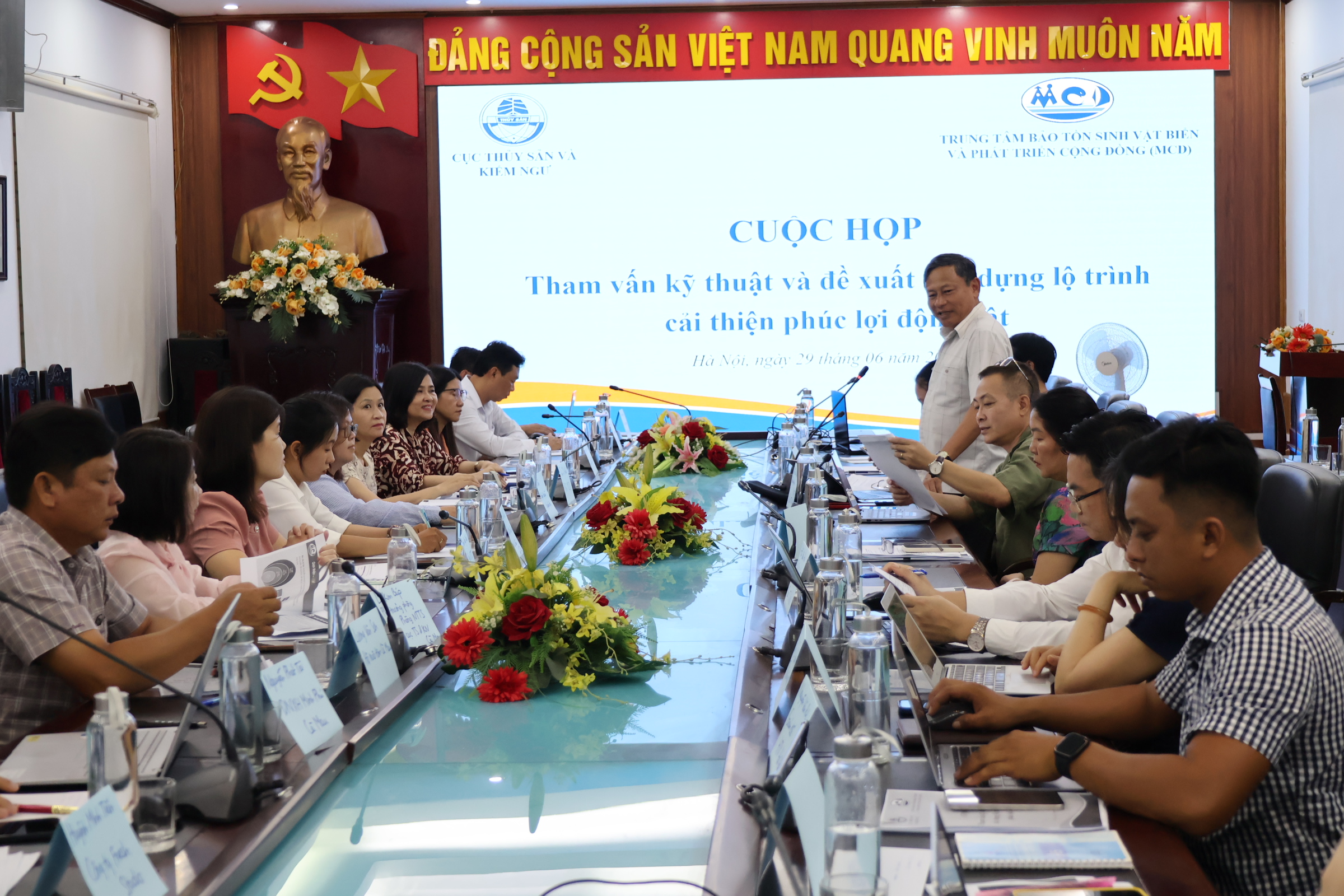
The primary objective of the meeting was to provide technical consultation for finalizing the guidance on improving the welfare of farmed shrimp and fish and to propose a roadmap for enhancing the welfare of farmed aquatic animals in Vietnam. During the meeting, participants received updates on a range of important topics, including an overview of aquatic animal welfare in Vietnam; the latest animal welfare requirements and practices under international certification standards; and MCD’s initiative on improving shrimp and fish welfare together with the draft technical guidance on aquatic animal welfare improvement. Following the question-and-answer session, participants engaged in active and constructive discussions on the Draft Technical Guidance and the Roadmap for Improving the Welfare of Farmed Aquatic Animals in Vietnam, contributing valuable comments and recommendations for their further refinement.
The participants reached a consensus that, as importing markets continue to impose increasingly stringent requirements on responsibility and sustainable development, the welfare of farmed aquatic animals is becoming a key component of the sustainable development of the fisheries sector. Numerous international studies have confirmed that aquatic animal welfare is one of the critical factors influencing product quality, market access, competitiveness, and the sustainable development of aquatic value chains.
To support the assessment of aquatic animal welfare, MCD has developed an overview of aquatic animal welfare indicators based on four key pillars: (i) farming environment, including water temperature, pH, salinity, and the control of predators and harmful organisms; (ii) nutrition, including feed quantity and feeding frequency; (iii) animal health, including physical condition, survival rate, and other health indicators; and (iv) behaviour, including swimming behaviour and responses during harvesting and processing. Based on this framework, MCD has also developed practical guidance on improving aquatic animal welfare.
With regard to the farming environment, the guidance covers site selection, pond preparation, water preparation, and water quality management throughout the farming cycle, including monitoring water colour, water transparency, and the application of biofloc systems. For aquatic animal nutrition, it provides recommendations on feed selection, feed storage, feeding practices, and monitoring and adjusting feeding rates and frequencies. To ensure animal health, the guidance promotes the application of disease prevention measures based on risk factors, appropriate disease treatment, careful use of supportive products, and effective disease outbreak management. Regarding animal behaviour, it emphasizes the early identification of abnormal behavioural signs and the early diagnosis of diseases. For harvesting, transportation, and processing, the guidance recommends the adoption of advanced techniques to minimize stress on aquatic animals throughout these stages.
Overall, investing in aquatic animal welfare and adopting humane practices (such as stunning animals before handling and processing) not only reflects ethical responsibility but is also an essential requirement for ensuring the sustainable development of Vietnam’s fisheries sector, enhancing product value, and maintaining international competitiveness. MCD therefore hopes that, in the coming years, the fisheries sector will integrate aquatic animal welfare into its sustainable development objectives. Given that this remains a relatively new topic in Vietnam, the Department of Fisheries and Surveillance encourages the Vietnamese fisheries sector to proactively embrace and implement aquatic animal welfare improvements in order to meet evolving international requirements.
The Department of Fisheries and Surveillance also reaffirmed its commitment to supporting research, application, and implementation of initiatives that promote sustainability. Today, aquatic animal welfare has become an inevitable global trend and a mandatory requirement in major seafood markets worldwide. Therefore, developing appropriate technical guidance and a practical implementation roadmap will provide an important foundation for gradually integrating aquatic animal welfare standards into farming practices while ensuring their feasibility for Vietnamese producers and seafood enterprises.
By Ngoc Thuy, Ficen
Read more
- CA MAU: MCD SUPPORTS THE SHARING OF INFORMATION, KNOWLEDGE, AND LESSONS LEARNED ON THE APPLICATION OF MARINE CONSERVATION TOOLS FOR BIODIVERSITY CONSERVATION AND FISHERIES RESOURCE PROTECTION
- KHANH HOA: RESPONDING TO VIETNAM SEA AND ISLAND WEEK 2026 – MCD SUPPORTS TECHNICAL TRAINING ON ENVIRONMENTALLY FRIENDLY AQUACULTURE FOR THE VAN HUNG COMMUNITY
- One in the Series of News Celebrating MCD’s 23rd Anniversary – MCD SUPPORTS QUANG NINH IN THE PROCESS OF ESTABLISHING CO TO – DAO TRAN MARINE PROTECTED AREA